Phở (say it roughly "fuh" with a dipping-then-rising tone) is a beef noodle soup with flat rice noodles that appeared in northern Vietnam in the early 20th century. Exactly where is disputed.
The broth is the point: beef bones simmer at least three hours with charred ginger and onion and toasted spices such as star anise, cinnamon and cloves.
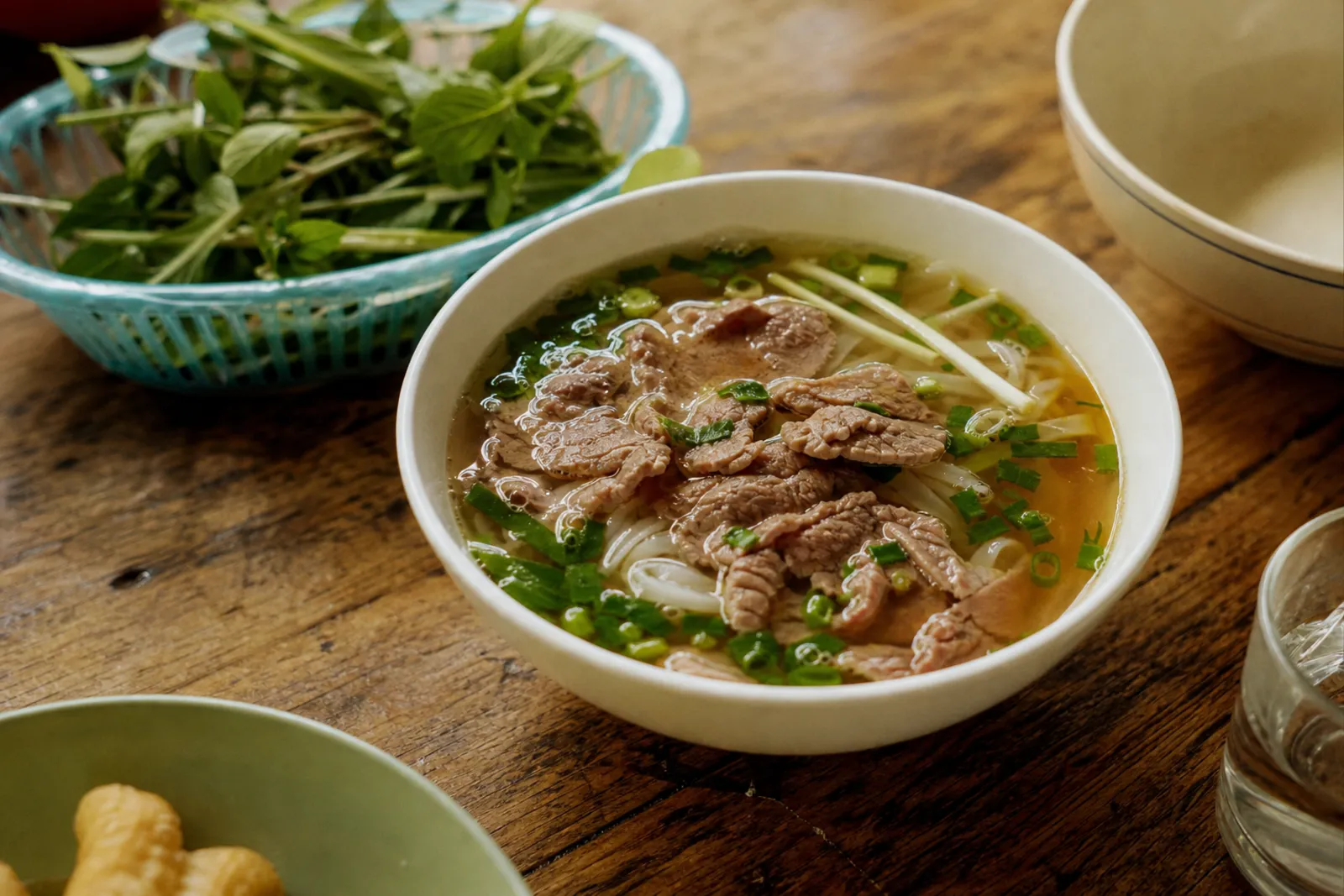
Hanoi serves the plainer, clearer bowl with scallions. Saigon goes sweeter and adds a plate of herbs, bean sprouts, lime and sauces for you to season at the table.
Home cooking works well outside Vietnam if you pick bones, spices, good fish sauce and fresh toppings carefully. The rest is patience.
What phở actually is
Order "pho" in most Western cities and you get something between an instant-noodle soup and a thin beef stock. That is a pity, because done properly phở is a precise dish: a clear, deep broth from beef bones, flat rice noodles (bánh phở), beef in different degrees of doneness and fresh herbs. Nothing else. There is no sauce to hide behind. Either the broth carries the bowl or it does not.
The word sounds like "fuh" with a tone that falls and then rises slightly. The hook above the o is not decoration but the tone mark (hỏi tone). Without it the syllable is a different one. Hardly anyone hears the difference in a restaurant, but you see it at once on a menu: places that set the mark correctly usually know what they are doing.
minimum broth simmer
3 h+
minimum broth simmer
styles: Hanoi and Saigon
2
styles: Hanoi and Saigon
years in its current form, roughly
~100
years in its current form, roughly
Phở is breakfast, but not only. In Hanoi the pots sit on street corners from the early morning and many stalls close at noon once the broth is gone. People eat it in the evening too. Among Vietnamese living abroad it is the dish most often named as comfort food from home. How the bowl works at the table is covered in eating phở: culture and etiquette.
Two terms get mixed up. "Phở" names the whole dish, but originally also the noodle itself: bánh phở are broad, flat ribbons of rice flour, cut fresh from a thinly steamed sheet of batter. The dried noodles you mostly buy abroad are the practical solution; fresh ones are softer and take up the broth better. The bowl is more often called bát in the north and tô in the south, so "một tô phở" in Saigon gets you what Hanoi calls "một bát phở".
Then the question of the meat. By the common account the original form was phở chín, fully cooked beef. Raw beef that cooks in the broth (tái) is said to have come later. Dates vary, so we do not commit. What is certain: the broth has to work for both anyway.
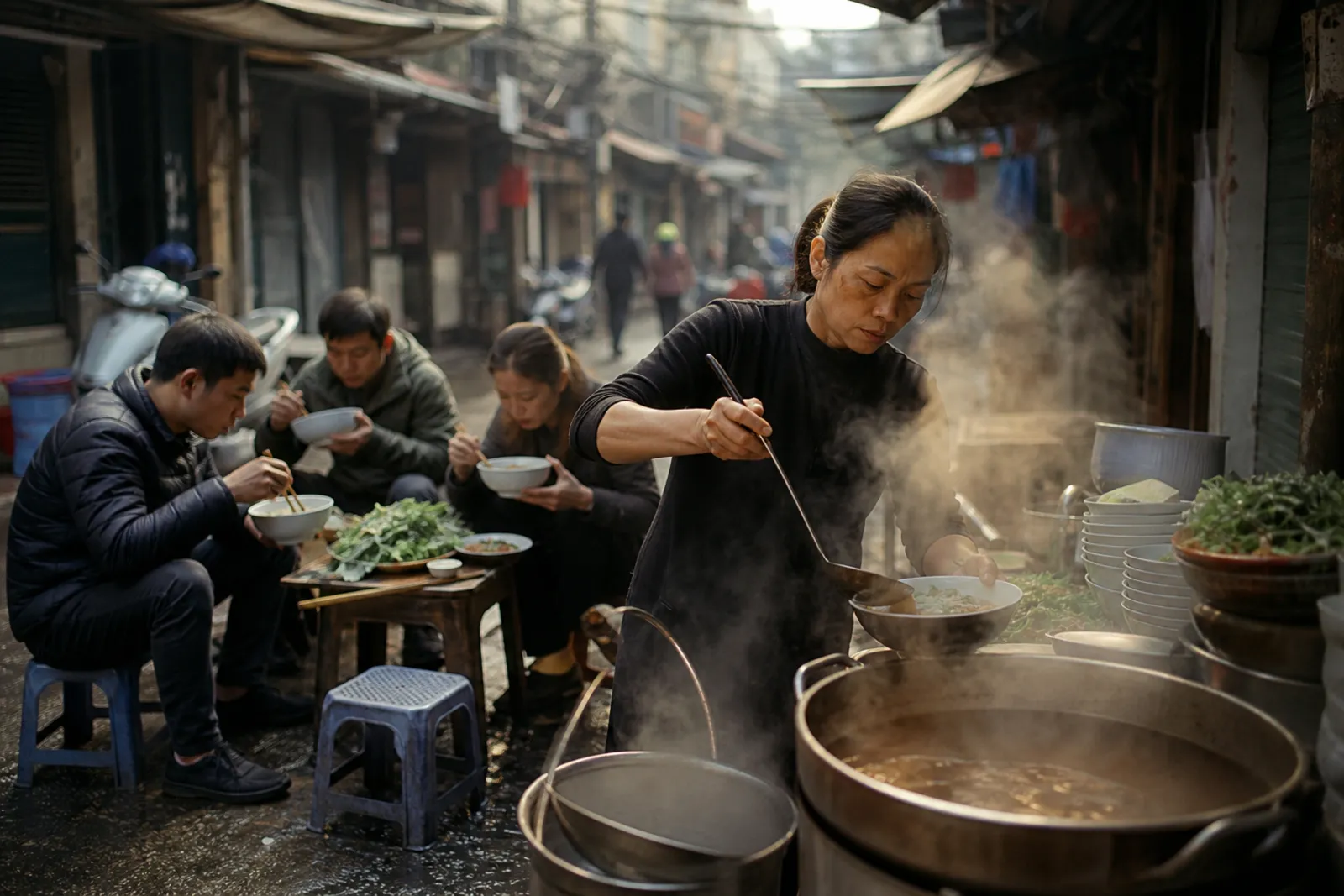
AI imagePhở starts early in Hanoi: a pot, low stools, a bowl in your hands.
Hanoi or Saigon: two philosophies
"Which one is the real phở?" is the wrong question. Both are real, they just want different things. Hanoi bets on the broth. It is clearer, restrained in spice, and what you see in the bowl is little: noodles, beef, scallions, maybe coriander. Some chili, some lime, done. Pour hoisin over a Hanoi bowl and expect a look.
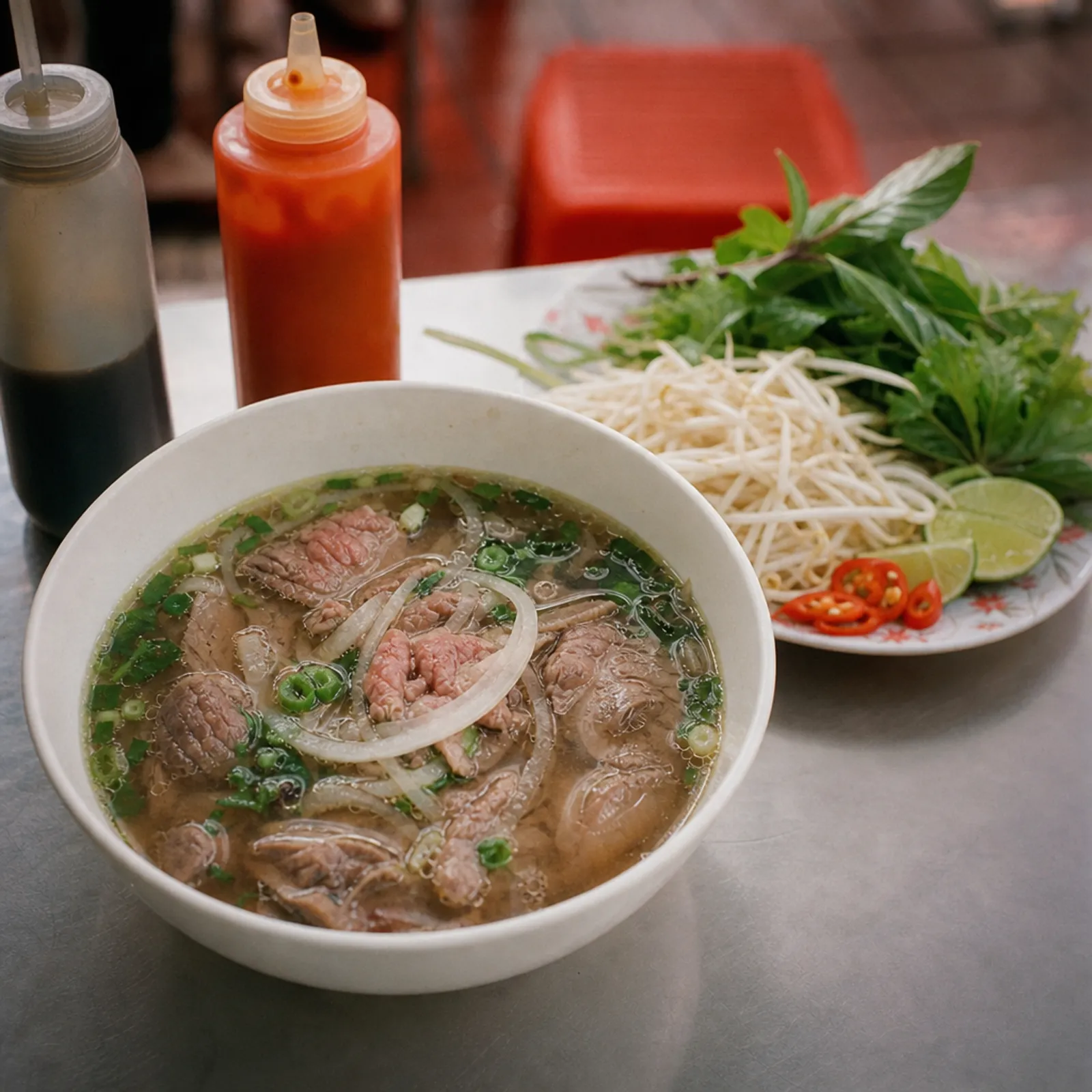
Saigon (Ho Chi Minh City) turns it into a do-it-yourself meal. The broth is usually sweeter, and next to the bowl comes a plate of bean sprouts, Thai basil, sawtooth coriander, lime and chili, with hoisin and chili sauce on the table. You build your own bowl. Neither is better; they mirror a city that guards tradition and one that changes faster.
Comparison
Trait
Hanoi (Phở Hà Nội)
Saigon (Phở Sài Gòn)
Broth
clear, beef-forward, restrained spices
often sweeter, bolder spice
Toppings
scallions, few herbs
plate of bean sprouts, basil, sawtooth coriander, lime, chili
Table sauces
chili, lime, garlic vinegar
hoisin, sriracha or chili sauce common
Side
quẩy (fried dough sticks) for dipping
less common, herb plate instead
No prices shown, they change daily on Amazon.
The table describes a tendency, not a law. Many Hanoi shops now put herbs on the table, and in Saigon plenty of signs read "Phở Bắc", phở in the northern manner, because there is demand for the clear, strict version. What stays is the basic attitude: the north hands you the finished bowl and expects you to trust it; the south hands you a construction kit.
Why the south cooks sweeter and herbier is usually explained by the Mekong Delta, sugarcane, vegetables and a cuisine that likes sweet, hot and fresh at once. Plausible explanations, not proof. As a reference point for the strict northern style many people name Bát Đàn street in Hanoi's Old Quarter, where a shop called Phở Gia Truyền is known for long queues and a very reduced offer. Whether the best bowl in town is there is a standing argument among Hanoians, and a matter of taste.
1. Hà Nội
The home of the legend: phở from the pot on the corner, phở gánh (carried on a pole), later the famous shops of the Old Quarter.
2. Nam Định
The provincial city southeast of Hanoi is often named as the cradle of the dish. The villages of Vân Cù and Đào Cù are often named as the home of the first phở cooks; what is solidly documented is mainly that many early sellers came from this area. The exact origin remains an argument.
3. Sài Gòn
After 1954, refugees from the north brought the dish south, where it grew into the herb-and-sauce version.
AI imageSaigon style: taste first, then build your own bowl with herbs and sauces.
Origins and history: beef, France, arguments
The honest answer on origins is that phở is young and the story is messy. What is reasonably established is that it appears in northern Vietnam in the early 20th century, around Hanoi and Nam Định. Before that, far less beef was eaten in Vietnam, since cattle were working animals.
Two explanations compete. One points to French colonial influence: more beef consumption, bones as a butcher's by-product, and a broth reminiscent of pot-au-feu. Deriving the word "phở" from feu (fire) is a popular story, but most specialists view it sceptically. The other points to Chinese beef noodle soups (ngưu nhục phấn) that traders from southern China brought north. The truth is probably a blend: a Vietnamese dish that drew ingredients and techniques from several sources and made something new.
The name is as contested as the dish. The French reading leads to feu: pretty, but it has a problem. The broth differs from pot-au-feu more than it resembles it, because star anise, charred ginger, fish sauce and rice noodles are not French ingredients. The Chinese reading starts from 牛肉粉, Vietnamese ngưu nhục phấn, roughly "beef rice noodles"; "phấn" would then have shrunk to "phở". Phonetically that is more plausible, but also unproven.
A third trail leads to xáo trâu, a simple water buffalo stew said to have been sold at the Red River landings. Vietnamese researchers consider it a possible precursor: first the poor man's buffalo broth, then beef broth with rice noodles. This too stays a hypothesis, but one that explains why a "French" or "Chinese" dish tastes so Vietnamese.
Nam Định, where Chinese and Vietnamese lived close together, is often named as the older home. From the 1930s phở turns up frequently in newspapers and memoir literature; Thạch Lam, for one, gave it a section in his Hanoi sketches. Earlier evidence is thin, and that is a statement in itself: phở was street food, and street food gets written about late.
Early 1900s
Phở emerges in the north
Beef noodle soup appears around Nam Định and Hanoi, first sold by hawkers carrying pots and bowls on shoulder poles (gánh). Several sources put the arrival of "Nam Định style" stalls in Hanoi around 1925; exact dates are not secured.
1954
The country is divided
After the Geneva Accords an estimated 800,000 to one million people move from north to south, many of them Catholics. They bring phở and it gets adapted.
From 1975
Phở goes global
With refugees after the war, phở shops open in the US, France and later Germany. A Hanoi breakfast becomes a worldwide piece of Vietnam.
In the north phở stayed a dish that lived on scarcity after 1954. In the years of the planned economy, roughly 1975 to the mid-1980s, state canteens served bowls with very little meat, known colloquially as phở không người lái, "pilotless phở": no meat, just broth, noodles and often a piece of bread on the side. Whoever spoons a dense, meaty broth in Hanoi today is also spooning a rebirth.
In the south the dish met a very different kitchen. More vegetables, more herbs, more sugar: the refugees from the north adapted their bowls to their guests, and the guests assembled them themselves. That is how the herb plate came about that we now consider "typical phở", although from Hanoi's point of view it is a southern speciality.
After 1975 the dish also reached Germany. West Germany took in boat people from 1979 (the ship Cap Anamur rescued people in the South China Sea), East Germany brought in contract workers from Vietnam. Both groups shaped the Vietnamese community here. Phở as a restaurant dish for everyone is clearly younger in German cities; for a long time it was something for the community itself.
A note on sources: most of what we know about early phở history rests on memoirs, oral accounts and newspaper pieces, not archive documents. Anyone who sells you one single "true" origin is overselling.
Why the broth decides everything
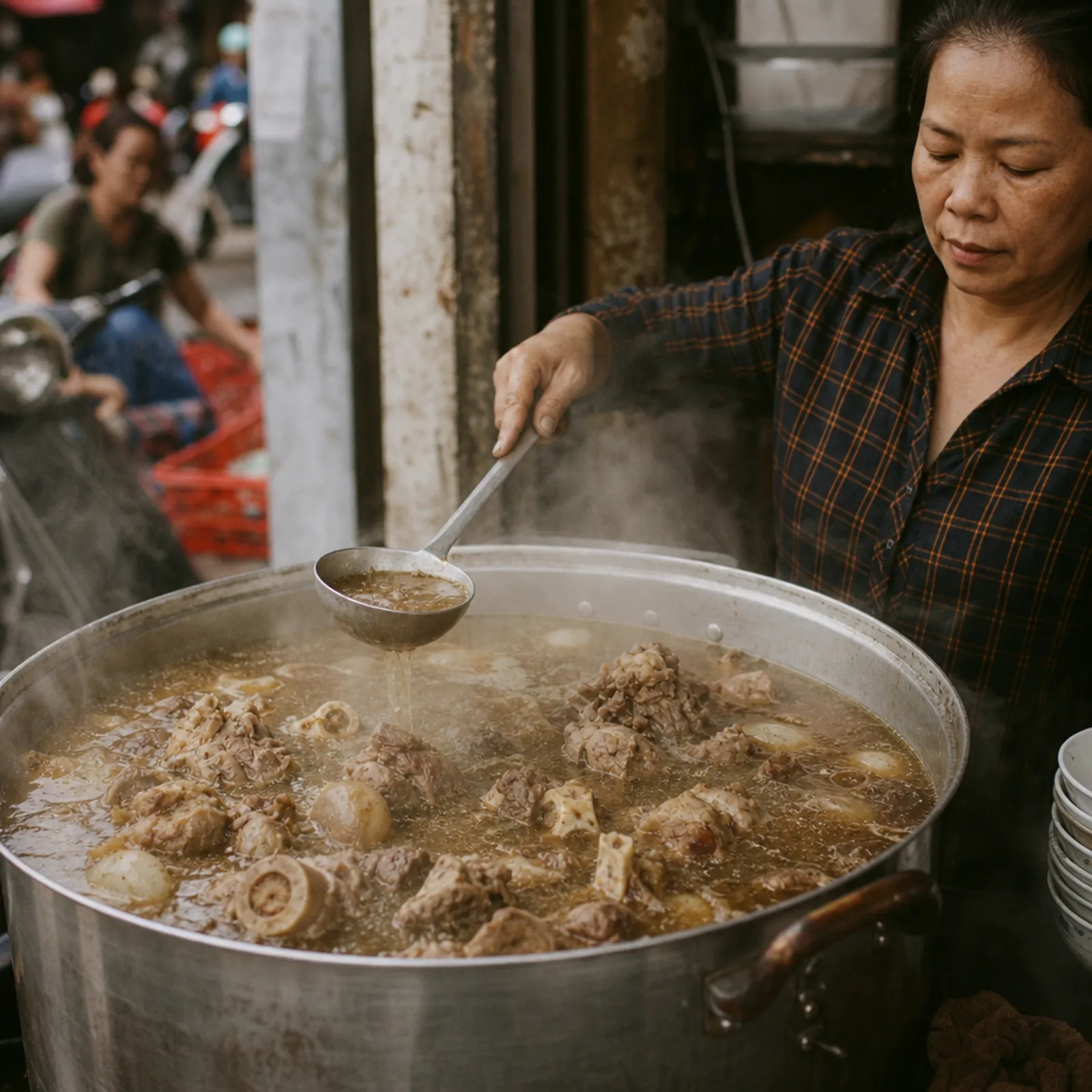
The broth is 90 percent of the work and nearly all of the flavour. It needs marrow bones, a little meat on the bone, at least three hours of quiet simmering and constant skimming. Add charred ginger and onion halves, blackened over a flame or in a pan. That gives sweetness and smoke you cannot add later.
The spices are dry-toasted: star anise, cassia cinnamon, cloves, coriander seeds, often a piece of black cardamom. Fish sauce goes in at the end, not earlier, so it does not cloud or turn bitter. Details are in phở spices and ingredients and the fish sauce buying guide. The step-by-step recipe is in how to cook phở bò.
What goes into the pot in practice? Marrow bones (beef leg bones) for depth, oxtail or ribs for meaty flavour, plus brisket or flank, which cooks along and is sliced onto the noodles later. It should only bubble quietly, the lid sits half on, and the fat is skimmed but not completely: a thin film carries aroma. Many stalls start the pot at night so it is ready by morning.
Sweetness ideally comes from the bones and the charred onions, not from the sugar bowl. In the south the broth is often rounded off with rock sugar (đường phèn), in the north sparingly or not at all. An honest remark belongs here too: many shops in Vietnam use MSG (bột ngọt), some openly, some not. At home you do not need it if bones and charred aromatics are right.
How to taste the broth: first sweetness and meat, in the middle the warmth of ginger and cinnamon, right at the back star anise, quietly. If the bowl mostly smells of cinnamon and anise, like mulled wine, the broth is being covered up. Then the base is too thin.
AI imageThe pot is the heart: the more time, the clearer and deeper the broth.
Two things that really make a difference
This page contains affiliate links. As an Amazon Associate we earn from qualifying purchases. The price for you stays the same.
Our pick
Reisbandnudeln Bánh Phở (getrocknet)
Dried rice noodles are the practical choice outside Vietnam. Fresh is better, but only big Asian supermarkets stock it.
Phở bò, the beef version, is what everyone thinks of first. Next to it phở gà with chicken has won a firm place, especially in the north. The broth is lighter and sweeter, the chicken is shredded or sliced, and it comes with lime leaves and pepper rather than hoisin. People who have never had phở bò often start here because the broth hits less hard.
Then there are offshoots. Phở cuốn are rolls of fresh noodle sheets with beef and herbs, dipped in a sweet-sour sauce and credited to Hanoi. Phở xào is stir-fried noodles with beef and vegetables. Phở khô ("dry") from Gia Lai province is served without broth, with a small bowl of broth on the side. And phở chay is the vegetarian bowl with a broth of mushrooms, vegetables and toasted spices.
If you want something other than the standard bowl, there is plenty to explore. But no variant replaces the basic question: is the broth good?
Phở outside Vietnam: eat out or cook?
The honest advice: eat first, cook later. You only know what is missing in your own pot once you have had a good bowl. In bigger cities there are Vietnamese-run places that treat phở as a speciality; look for a clear, not milky, broth, herbs on a plate and noodles that are not overcooked.
As a recipe phở is not difficult but long. Give it a weekend: bones and broth on Saturday, eat on Sunday. The home equipment costs less than you think; a big pot, a fine strainer and good bowls are enough. Many overseas Vietnamese cook large batches and freeze broth in portions. That is the sensible way here, too.
Three checks for a restaurant bowl. First the colour: golden-brown and clear, fat droplets transparent, not milky white and not dark like soy sauce. Second the meat: pink to light brown, paper-thin, not grey and not dry. Third the noodles: soft but with bite, and the bowl should not swim in a broth that tastes only of salt. If you reach for the chili sauce after three sips and forget the spoon, something is missing in the broth.
Also simply ask how long the pot has been cooking. Someone proud answers proudly. Someone who dodges has often used powder.
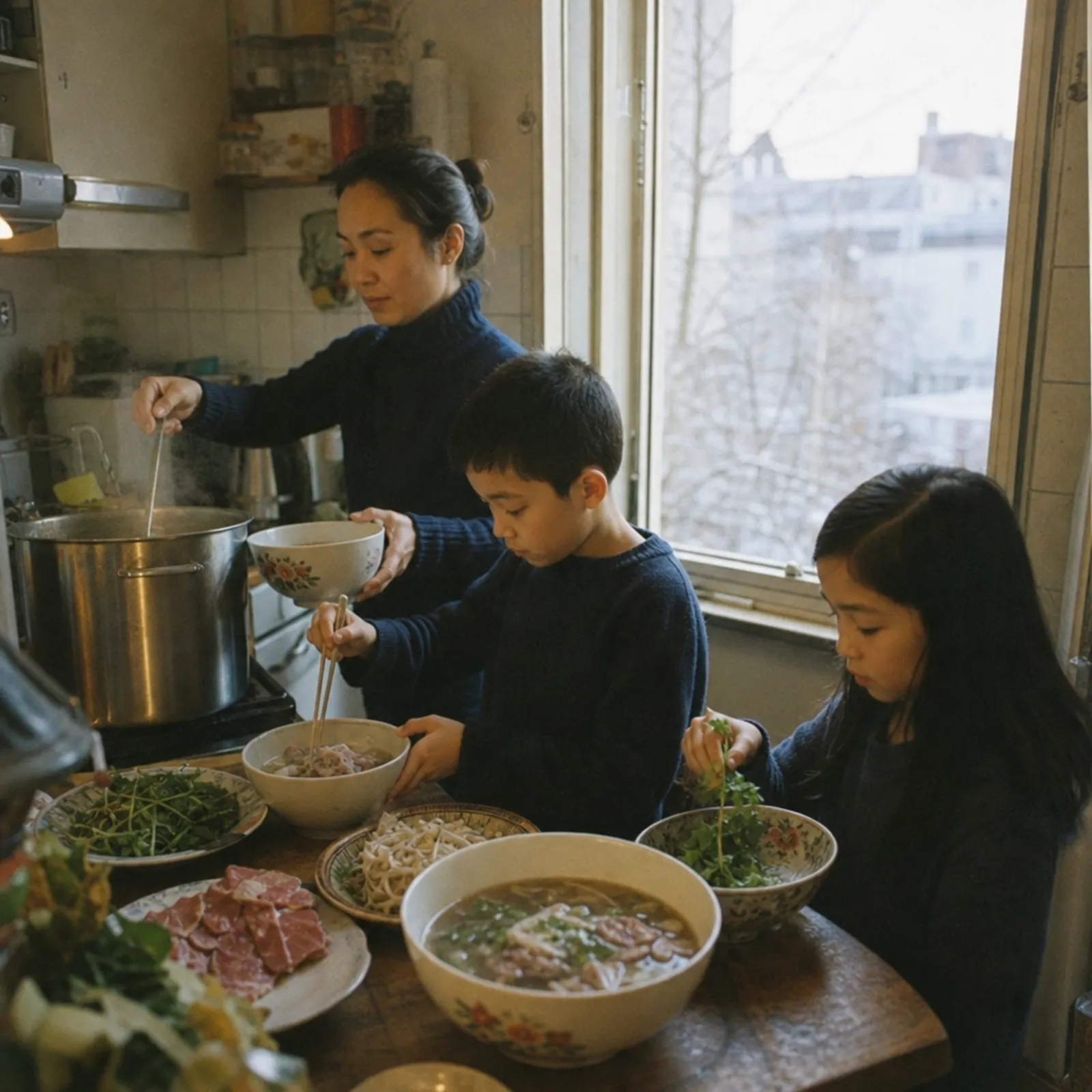
AI imagePhở in a small apartment kitchen: it works in a European winter too.
If you cook phở yourself for the first time, plan a trial run with a small batch. Two kilos of bones, a big pot, an oven or gas flame for charring, nothing more. Cook the broth the day before, chill it overnight and lift off the set fat next day; that makes the fat level much easier to control. Buy meat that slices thinly (freezing it briefly helps) and cook noodles only just before serving. The order on the serving evening is simple: heat the bowls, noodles in, meat on top, boiling broth over it. Everything else is adjusting seasoning.
Frequently asked questions
How do you pronounce phở?
Roughly "fuh", with a tone that falls then rises a little. The "ph" is a plain "f". It is not "po" or "pfo".
What is the difference between phở bò and phở gà?
Phở bò is made with beef, phở gà with chicken. Both use flat rice noodles. The beef broth is stronger, the chicken one lighter and quicker.
Is phở healthy?
It depends on the bowl. Phở combines broth, rice noodles and lean meat and is usually less greasy than many stir-fried dishes. Salt and noodle quantity are not small, though. Specific nutrition values vary with portion and recipe, so I do not quote a number.
How long must the broth cook?
At least three hours. A pressure cooker gets you to a usable broth in about an hour, though it stays less deep.
Is there a vegetarian phở?
Yes, phở chay. The broth is built on vegetables, mushrooms, toasted spices and soy sauce instead of fish sauce. It is a style of its own, not a substitute for the beef version.
Where do I buy ingredients?
In Asian shops and online. Bánh phở (rice noodles), star anise and fish sauce are easy to find; see the guide to [spices and ingredients](/en/guides/vietnamese-pho/pho-spices-and-ingredients).