Phở-Gewürzset (Sternanis, Zimt, Nelken, Kardamom)
A ready set with star anise, cinnamon, cloves and cardamom saves the hunt. The price is convenience.
- everything in one pack
- sensible amounts
- freshness varies
- black cardamom rarely included
AI imageShopping
Five spices, two aromatics, fish sauce and the right noodles. No more, no less.
Phở broth lives on a tight set of spices. Fewer than an Indian curry blend, more than a supermarket soup. What matters is that they are whole and dry-toasted until fragrant. Ground spices make the broth cloudy and dull.
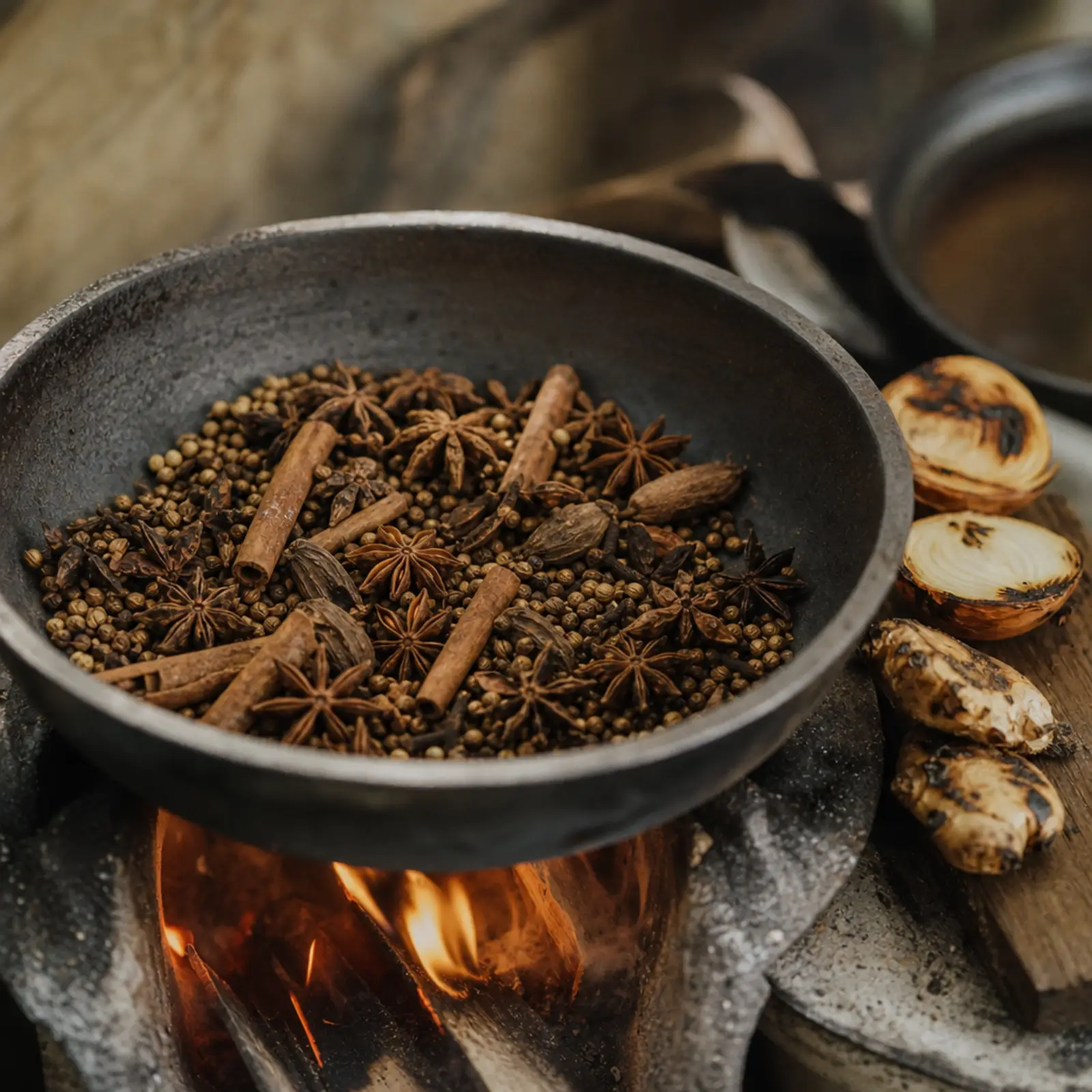
Star anise is the lead note, sweet and liquorice-like. Three stars are enough for four litres. Cinnamon should be cassia, the strong reddish-brown bark. Ceylon cinnamon is finer and better for baking. Cloves need just four; they take over fast. Coriander seeds add a citrus warmth. Black cardamom (Vietnamese thảo quả) is a large, dark, wrinkled pod with a smoky aroma, not to be confused with sweet green cardamom. If you cannot find it, leave it out instead of using the green kind. True thảo quả (Amomum tsao-ko) is a little larger than Indian black cardamom, which is a workable substitute.
Freshness and storage. Whole spices keep well; a year in the dark and airtight is realistic, though after six months you notice the loss. Test: rub a star anise between your fingers. If it smells strong, it is good; if it smells dusty, it is old. In an Asian grocery you can usually buy star anise, cinnamon and cloves by the bag far cheaper than as a jar in the supermarket, and the turnover is higher.
Toasting properly. A dry pan on medium heat, not hot. Spices in a single layer, shake every 20 to 30 seconds. They are done as soon as they smell intense and turn slightly darker; you rarely need more than three minutes. If it smells acrid, they were too hot and will stay bitter. Black cardamom is cracked or slightly opened beforehand so the seeds release aroma. The bag is no luxury: loose spices in the pot stay lodged in the broth and cannot be removed.
Dosage. The amounts above are a starting point for four litres of broth, not dogma; most sources land at 2 to 4 star anise and 4 to 8 cloves per four litres, here deliberately at the restrained end. The broth should smell of beef, not of gingerbread. Cooking this for the first time, stick to the amounts and adjust next time.
My verdict on ready-made sets. A set pays off if you only cook once or have no Asian grocery nearby. For everyone else buying individually is cheaper and fresher. A set with broken pieces or lots of dust at the bottom is a warning sign.
| Spice | Role | Amount for 4 l broth | Note | View on Amazon |
|---|---|---|---|---|
| Star anise | lead aroma, sweet | 3 stars | food-grade only | View on Amazon |
| Cinnamon (cassia) | warmth, depth | 1 stick, about 7 cm | cassia, not Ceylon | View on Amazon |
| Black cardamom | smoke, resin | 1 pod | not green cardamom | View on Amazon |
| Cloves | sharp spice | 4 pieces | use sparingly | |
| Coriander seeds | citrus, warmth | 1 tsp | whole, not ground | |
| Fennel seeds | mild sweetness, aniseed | 1 tsp, optional | whole; not every recipe uses it |
No prices shown, they change daily on Amazon.
AI imageWithout charred onion and ginger the broth tastes flat. Both go cut side down into a dry pan, onto a grill or over a gas flame until dark brown to black at the edges. That gives a smoky sweetness no other trick replaces. Rinse afterwards so nothing burnt gets into the broth.
Sweetness traditionally comes from yellow rock sugar (đường phèn). It is milder than white sugar and dissolves slowly. If you cannot find it use a little brown sugar, but less than planned. The sweetness should round the broth, not make it sweet.
The salt base is decided by fish sauce, which deserves its own chapter: read the fish sauce guide.
Choosing onion and ginger. Take yellow onions or, Hanoi style, unpeeled shallots; both give sweetness. Ginger should be firm and plump, not shriveled. You do not have to peel it, but wash it thoroughly. About 80 g ginger for four litres is a value many recipes share; more makes the broth sharp, less leaves it colorless.
Fish sauce and salt. Fish sauce delivers salt and umami at once. Salt alone makes the broth flat, fish sauce alone makes it fishy. Both together, in small steps, give the best balance. Details and brands: fish sauce guide.
Other umami tricks you may meet. Some cooks add a piece of daikon, dried shrimp or an apple (Andrea Nguyen's Hanoi recipe) for sweetness or depth. These are legitimate variants but not required; the basic recipe works without them. I would try them only once the base is right.
This page contains affiliate links. As an Amazon Associate we earn from qualifying purchases. The price for you stays the same.
A ready set with star anise, cinnamon, cloves and cardamom saves the hunt. The price is convenience.
Whole star anise is the single most important ingredient for the broth.
Yellow rock sugar rounds the broth softly.
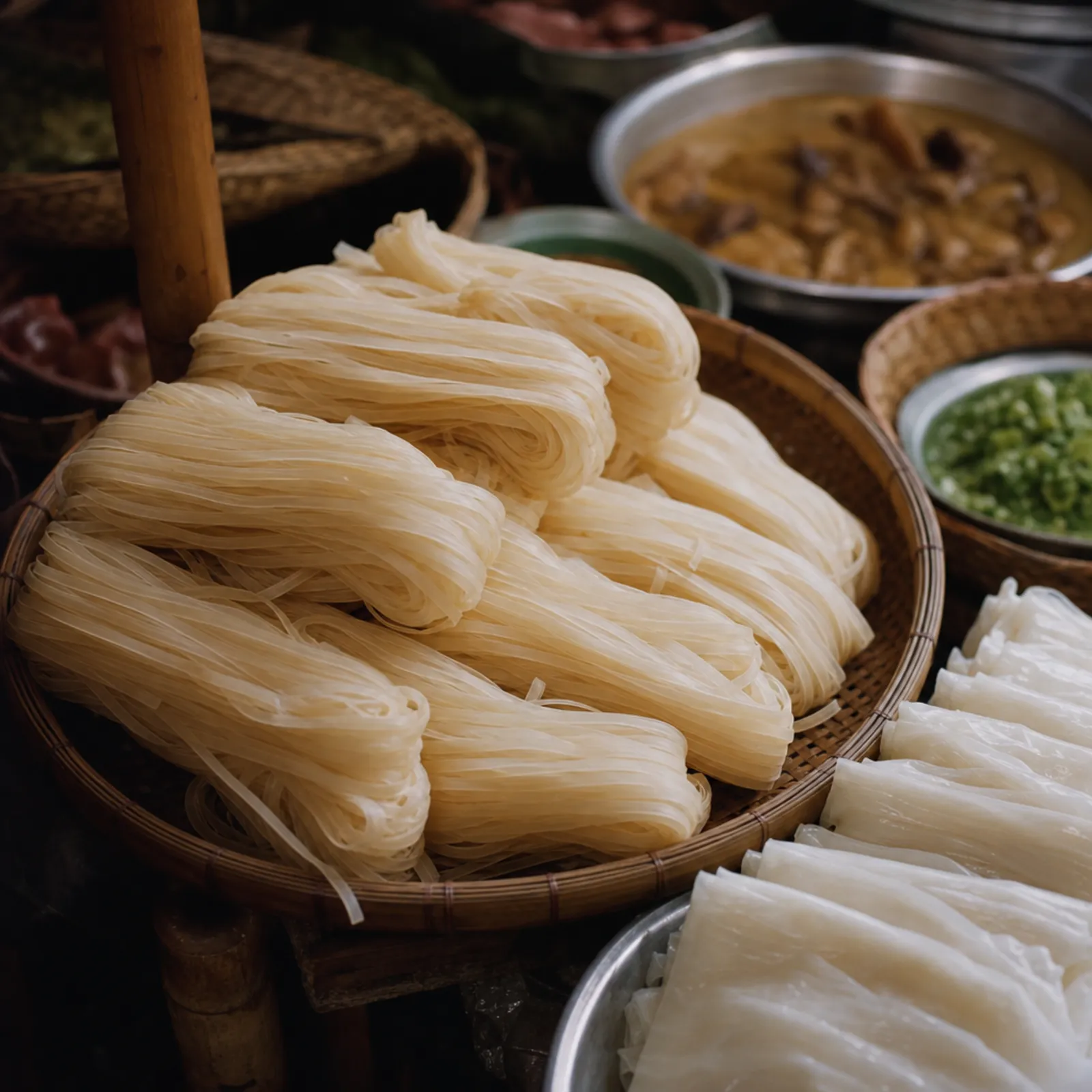
Bánh phở are flat noodles of rice flour and water. They come fresh (soft, like thin ribbons, cook in no time) and dried (hard, brittle, from a bag). In Germany Asian shops carry almost only dried, big ones sometimes fresh. Dried comes in several widths; start with medium.
Preparation: soak in warm water or boil briefly depending on the pack, then rinse cold so they stop cooking and do not stick. Noodles never go in the broth pot. At serving, put them in a warmed bowl and ladle boiling broth over.
Neighbours on the Vietnamese shelf are rice vermicelli for bún and rice paper (bánh tráng). What rice paper can do is explained in our guide on buying rice paper.
Width and choice. Dried bánh phở usually come in three widths: thin (about 1 to 2 mm, closer to bún-style dishes), medium (around 3 mm, the standard for pho) and wide (5 mm or more, suited to stir-fried dishes like phở xào). The package often says S, M, L or a number; the systems are not uniform. Medium is the safest choice.
Check the ingredient list. Good noodles are rice and water, sometimes with a little tapioca starch for bite. That is fine. Avoid packs with additives or odd color. Quality noodles stay slightly elastic after cooking and do not fall apart in hot broth.
Preparation. Soak in warm (not boiling) water for 20 to 30 minutes, then blanch in boiling water for 15 to 60 seconds depending on thickness. Follow the package, but taste: they should be al dente, because the hot broth keeps cooking them in the bowl.
This page contains affiliate links. As an Amazon Associate we earn from qualifying purchases. The price for you stays the same.
Medium-width dried bánh phở is the dependable everyday buy. Check the label: rice and water, as few additives as possible.
AI imageWhat else belongs on the table: bean sprouts, Thai basil (húng quế), sawtooth coriander (ngò gai), cilantro, lime, fresh chili and scallions. Much of it comes from an Asian shop, most from a normal supermarket (cilantro, lime, chili, sprouts). Thai basil and sawtooth coriander are rarer; swap in regular basil and a bit more cilantro if you must. The recipe in detail: phở bò recipe. Matching equipment: phở home kit.
A bowl of pho often comes with a plate of raw ingredients that you add as you like. This is a regional trait: in southern Vietnam the herb plate is generous, in the north (Hanoi) often only scallion and cilantro go straight into the bowl, with chili and lime on the side.
Bean sprouts (giá) bring crunch; pressed raw into the hot broth they end up half-cooked. Thai basil (húng quế) with its aniseed scent is the lead herb in the south. Sawtooth coriander (ngò gai) has a strong, cilantro-like flavor and is eaten raw as well. Cilantro and scallion are standard in both regions. Lime goes into the bowl just before eating, not into the pot. Fresh chili in slices is the hot option.
Sauces on the table. In southern Vietnam hoisin and sriracha often stand on the table. A common custom is not to stir them into the broth but to mix them in a small dish for dipping the meat. Putting them in the broth covers what you spent three hours building. It is a matter of taste, but: taste the broth plain first.
Other extras. Quẩy (fried dough sticks) for dunking and garlic pickled in vinegar (tỏi ngâm giấm) are typical in Hanoi. You will rarely find them outside Vietnam, but they are not a must.
Shopping list for one pot (four servings). Spices: 3 star anise, 1 stick cassia cinnamon, 4 cloves, 1 black cardamom, 1 tsp coriander seeds, optionally 1 tsp fennel seeds. Aromatics: 1 large onion, 80 g ginger, 30 g yellow rock sugar. Salt and fish sauce: one good bottle and sea salt. Noodles: 250 g medium dried bánh phở. Fresh: 4 scallions, cilantro, Thai basil, bean sprouts, limes, chili. Total cost without meat is usually ten to fifteen euros, much of it spices that last for several pots. All amounts match the recipe.
Better not. They cloud the broth and go flat quicker. Toast whole spices dry and cook them in a bag.
Nothing really. Leave it out if you cannot find it. Green cardamom only in small amounts, it tastes different.
Cassia suits phở better; it is stronger and survives the long cook. Ceylon is finer but gets lost.
In taste and texture yes. Dried are practical because they keep and are available everywhere.
Roughly 60 to 70 g dried or 150 to 200 g fresh per bowl. A rule of thumb, not a law.
An Asian shop or online. With Amazon links use the search term, check ingredient lists and the best-before date.
As an Amazon Associate we earn from qualifying purchases.